Among Korea’s traditional folktales, The Grateful Magpies is one of the most moving stories about kindness returned in an unexpected way. Unlike tales that focus only on fortune or clever tricks, this story leaves a deeper emotional impression through its quiet lesson about gratitude, sacrifice, and the invisible bond between living beings. Passed down in different forms across Korea, it remains one of the best-loved folktales because of its simple plot and powerful ending.
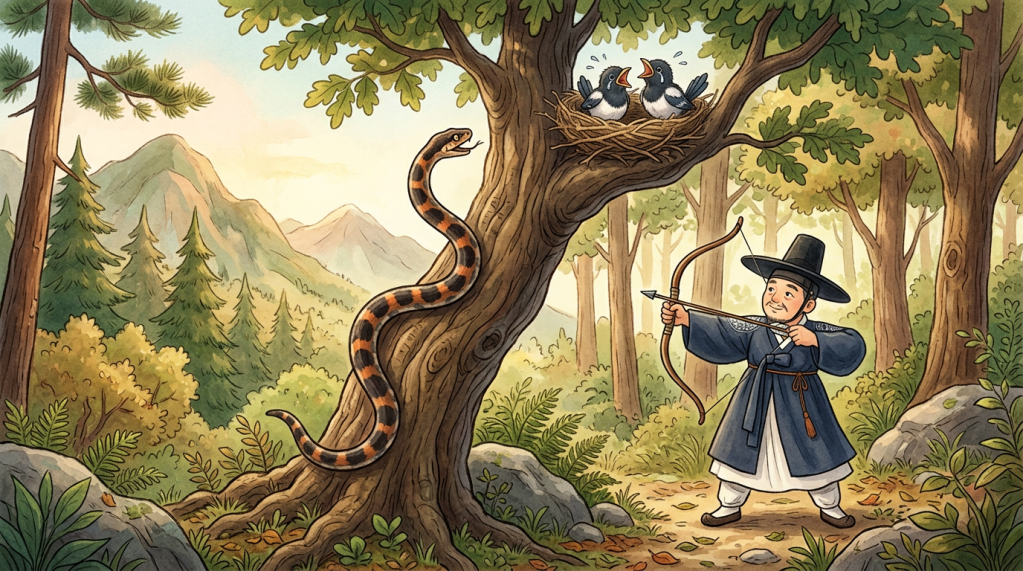
The story begins with a scholar traveling to Hanyang to take the government examination. On his journey through the mountains, he hears the desperate cries of baby magpies in a nest. Looking up, he sees a large serpent climbing the tree, ready to devour them. Moved by compassion, the scholar quickly draws his bow and shoots the serpent, saving the helpless chicks. The parent magpies seem to recognize his kindness, and after rescuing the birds, he quietly continues on his way
As night falls, the scholar finds a house and is welcomed by a mysterious woman dressed in white. She gives him a warm meal and a comfortable place to sleep. But in the middle of the night, he wakes in terror to find that a huge serpent has wrapped itself around his body. The woman, he realizes, was no ordinary host at all. She is the wife of the serpent he killed earlier that day, and she has come to avenge her husband’s death.
The serpent gives him one slim chance to live. She declares that if the temple bell behind the house rings three times before daybreak, she will spare his life. Otherwise, he must die. The scholar knows how impossible this sounds. No one would come to ring a bell in the deep night, and there is nothing he can do as the serpent tightens around him. The tension of the story reaches its height in this dark and helpless moment.
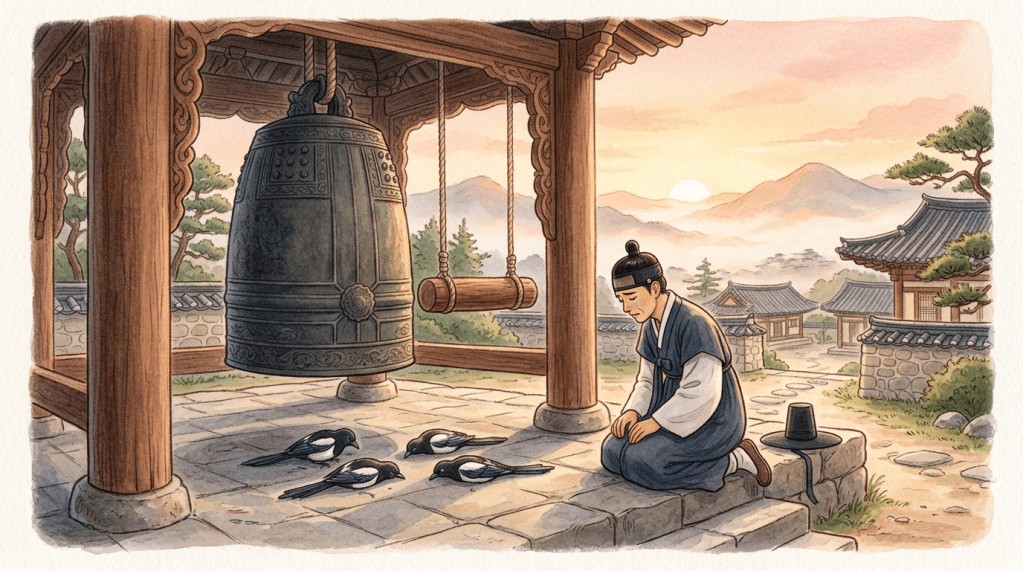
Then, just when all hope seems lost, the sound of a bell echoes through the night—once, twice, three times. Bound by her promise, the serpent releases the scholar. In some tellings, the serpent then transforms and ascends to the heavens, giving the tale an unexpected spiritual depth beyond revenge and rescue. At dawn, the scholar goes to the temple to discover what happened. There, beneath the great bell, he finds the lifeless bodies of magpies who had struck the bell with their heads to repay the kindness he had shown their young.
This is what makes The Grateful Magpies so unforgettable. The birds do not simply remember a good deed—they repay it with their own lives. Their sacrifice transforms the story from a simple moral tale into something more profound. It becomes a meditation on gratitude not as a polite feeling, but as a sacred duty carried out through action, loyalty, and love.
The tale can also be read in a broader emotional and spiritual way. The Korean Encyclopedia of National Culture notes that the ringing bell does more than save the scholar’s life; it also gives the story a sense of redemption and transcendence. In this sense, the folktale is not only about kindness being repaid, but also about how one act of compassion can ripple outward, touching lives in ways that cannot be predicted.

Modern readers may also find a different kind of beauty in the story. It suggests that animals are not merely passive creatures in human lives, but beings capable of recognition, memory, and moral action. Recent cultural interpretation even reads the story as a reminder that humans and non-human beings exist in an ethical relationship with one another. That idea makes this old folktale feel surprisingly meaningful in today’s world, where empathy and coexistence matter more than ever.
In some versions, the story is also linked to the legend of Mt. Chiak, where the tale takes on the character of a local legend as well as a folktale. But whether told as a mountain legend or a moral fable, the heart of the story remains the same: a single act of mercy is never truly lost. The Grateful Magpies continues to endure because it reminds us that kindness has meaning, gratitude has power, and even the smallest life may carry a great and noble heart.
 KOREAN FOLKTALES
Leave a comment