Among Korea’s many traditional folktales, The Snail Bride—known in Korean as Ureongi Gaksi—stands out as one of the most tender and mysterious. It is a story about poverty, quiet devotion, magical transformation, and the fragile hope of finding love in a difficult world. Passed down in many regions of Korea, the tale has been loved for generations not only because of its fairy-tale wonder, but also because of the sadness and longing hidden beneath its gentle surface.
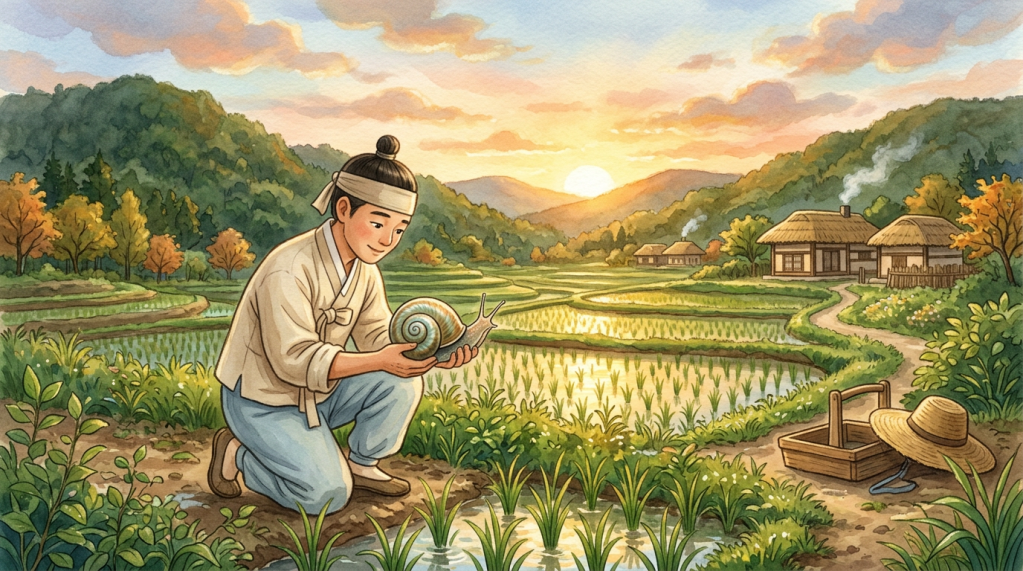
The story usually begins with a poor bachelor who lives alone and works hard in the fields. One day, while wondering who he is working so hard for, he hears a strange voice answer him. Following the sound, he finds a large snail and brings it home, placing it carefully in a water jar. From that day on, something miraculous begins to happen. Whenever he returns from work, a warm meal is already waiting for him. The lonely house that once felt empty is suddenly filled with care and comfort.
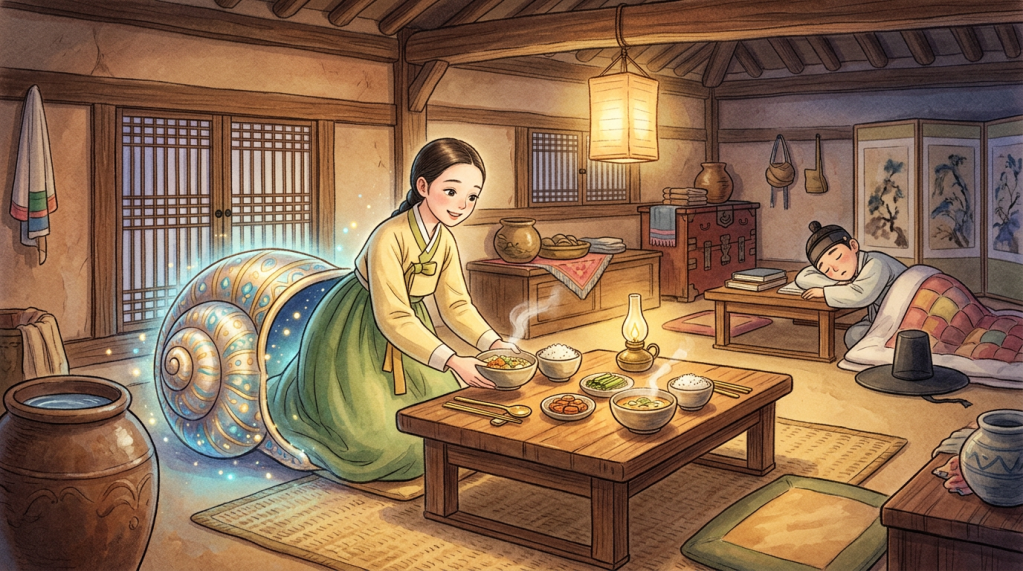
Curious and puzzled, the man decides to hide and watch. To his amazement, a beautiful young woman emerges from the snail shell and begins to cook and clean before quietly returning to it. When he reveals himself, he asks her to stay and live with him. In many versions of the story, she tells him that the time is not right yet and asks him to wait. But he cannot hold back his feelings, and the two begin to live together. This moment gives the folktale its dreamlike beauty: love appears not with noise or grandeur, but in the form of a secret kindness that has already been caring for him in silence.
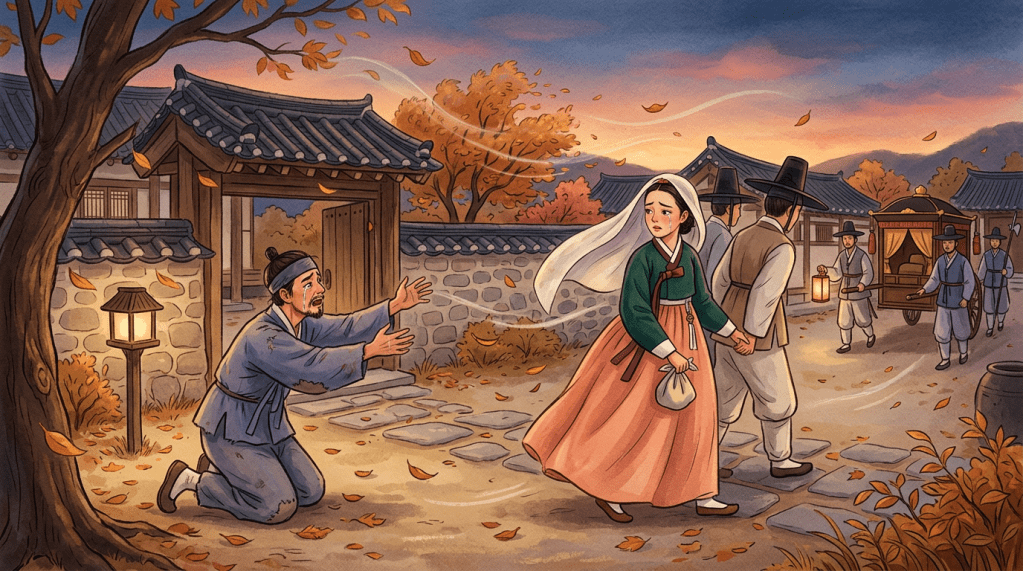
Yet The Snail Bride is not simply a happy fairy tale. In many traditional versions, their fragile life together is broken by outside power. While the snail bride is working, a passing official notices her beauty and tries to take her away. What follows turns the story from a magical romance into something far more emotional. In some versions, the couple is separated forever, and the story ends in grief. In others, the lovers are reunited through struggle, wit, or supernatural change. This variety of endings is part of what makes the tale so rich in Korean storytelling tradition.
Because of these different versions, The Snail Bride can be read in more than one way. On one level, it is a beautiful story about an unexpected love that enters an ordinary life like a miracle. On another, it reflects the hardship of common people whose happiness could easily be broken by poverty, social power, or fate. Some interpretations also see the tale as expressing a deep human wish—the wish that someone, somewhere, quietly understands our loneliness and takes care of us before we even ask. That emotional undercurrent may be one reason the story still feels moving today.
There is also a soft but powerful emotional contrast at the heart of the tale. The snail bride is magical, but the feelings in the story are deeply human: hunger, loneliness, affection, fear, and loss. The meal waiting on the table is more than food—it is a symbol of tenderness, home, and the comfort of being seen. What begins as a small miracle inside a humble house gradually becomes a story about how precious love can be, especially in a harsh and unequal world.
That is why The Snail Bride continues to resonate with modern readers. It is not only a tale of magical transformation, but also a deeply emotional folktale about care, longing, and the vulnerability of happiness. Even today, it feels quietly relevant. In a fast and noisy world, there is something deeply touching about a story in which love first appears as an unseen act of kindness, and where the greatest miracle is not magic itself, but the feeling of being cared for.
In the end, The Snail Bride remains one of Korea’s most memorable folktales because it combines beauty with sorrow, fantasy with reality, and wonder with emotional truth. It reminds us that love can arrive in the most unexpected form, that tenderness can change an empty life, and that even old folktales still carry feelings that modern readers understand immediately. That is the quiet power of Ureongi Gaksi—a story both magical and heartbreakingly human.
 KOREAN FOLKTALES
Leave a comment