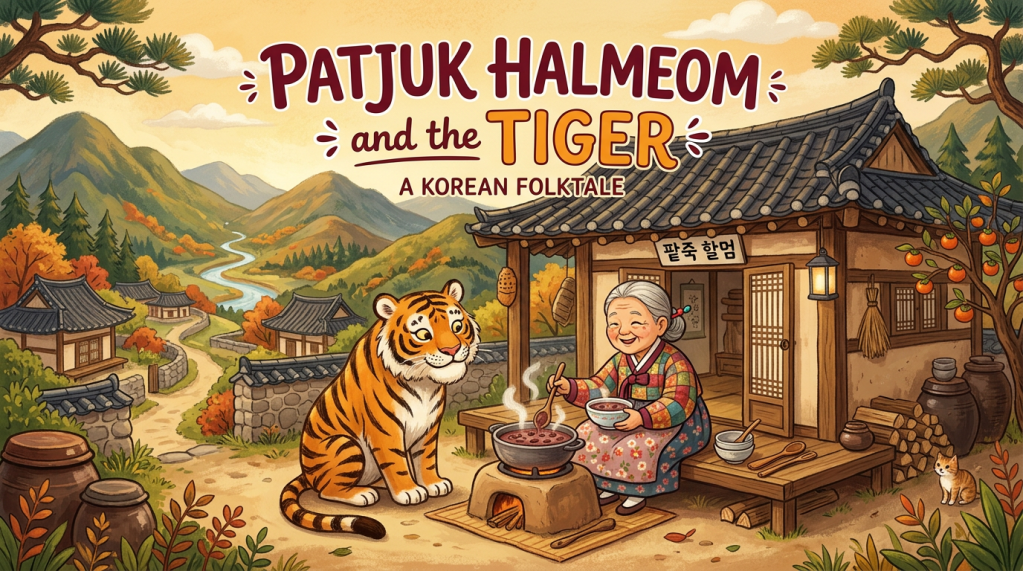
Among Korea’s traditional folktales, Patjuk Halmeom and the Tiger is one of the warmest and most entertaining. The title is often translated as “The Red Bean Porridge Granny and the Tiger.” At first, it sounds like a simple children’s story about an old woman and a hungry tiger. But beneath its playful tone, the tale carries themes of courage, mutual help, and the power of the small overcoming the strong. It also reflects Korea’s winter tradition of eating red bean porridge, especially on Dongji, the winter solstice.The story begins deep in the mountains, where an old woman lives alone and grows red beans in her field. One day, a huge tiger appears and threatens to eat her. Terrified but quick-thinking, the old woman pleads for more time. She tells the tiger to come back after she harvests her red beans and cooks him a proper bowl of red bean porridge. The tiger agrees and disappears into the mountain, certain that he will soon enjoy both the porridge and the old woman herself. This opening is simple, but it immediately establishes the contrast at the heart of the story: a weak old woman on one side, and a powerful predator on the other.
When the winter solstice finally arrives, the old woman cooks a large pot of fragrant red bean porridge. As the smell fills her small house, a series of unexpected visitors arrives. Depending on the version, chestnut, awl, straw mat, pestle, and jige come to share the porridge. The old woman, knowing this may be her last meal, welcomes them and tells them about the tiger’s promise. Instead of running away, these tiny and ordinary companions decide to help her. One by one, they hide themselves around the house and prepare to fight back in their own clever ways.
Before long, the tiger returns, expecting an easy victory. But the moment he enters the house, everything changes. As he lifts the lid of the pot, the chestnut flies out and strikes him. The awl jabs him, the pestle beats him, and the other helpers attack from every direction. What seemed like a lonely old woman’s final evening becomes a perfectly planned ambush. The tiger, confused and overwhelmed, cannot withstand the attack. In the end, he is driven away for good, and the old woman’s life is saved.
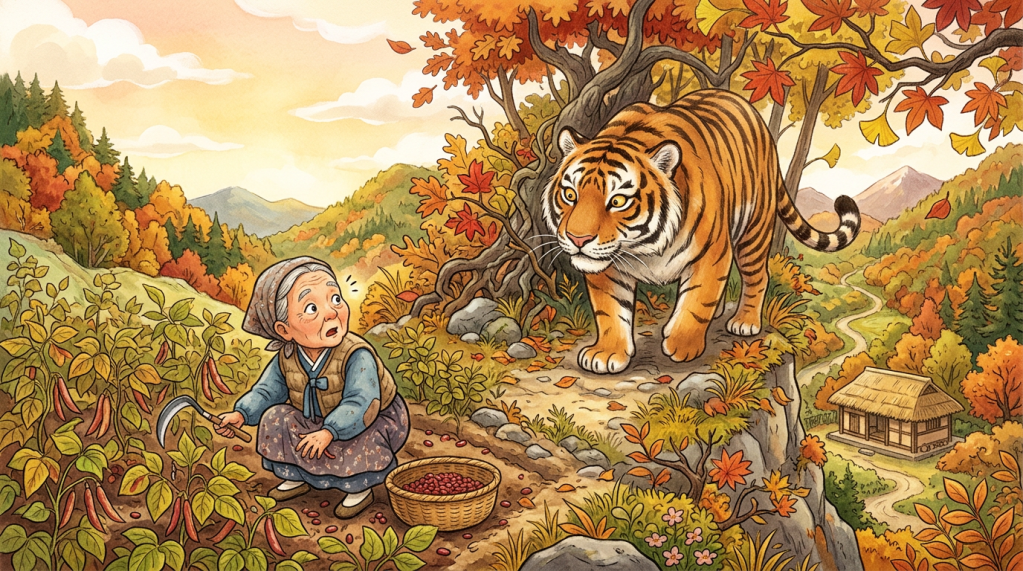
What makes this folktale so memorable is the way it turns everyday household objects and simple natural things into heroes. The old woman does not defeat the tiger with physical strength. She survives because help comes from unexpected places. The chestnut, the awl, the straw mat, and the pestle are all small, ordinary things, yet together they become stronger than a beast. This gives the story a cheerful and deeply satisfying structure. It tells children and adults alike that size and power do not decide everything. Sometimes wisdom, cooperation, and timing matter more.
The story also carries cultural meaning through patjuk, or red bean porridge. In Korean tradition, red bean porridge is closely associated with Dongji, the winter solstice, and has long been believed to drive away misfortune or harmful spirits. Because of this association, the tiger in the story can be understood not only as a wild animal, but also as a symbol of danger or bad fortune that must be chased away. In that sense, the tale is not merely funny. It is connected to seasonal custom, protective ritual, and the hope that warmth and food can protect a household from fear.
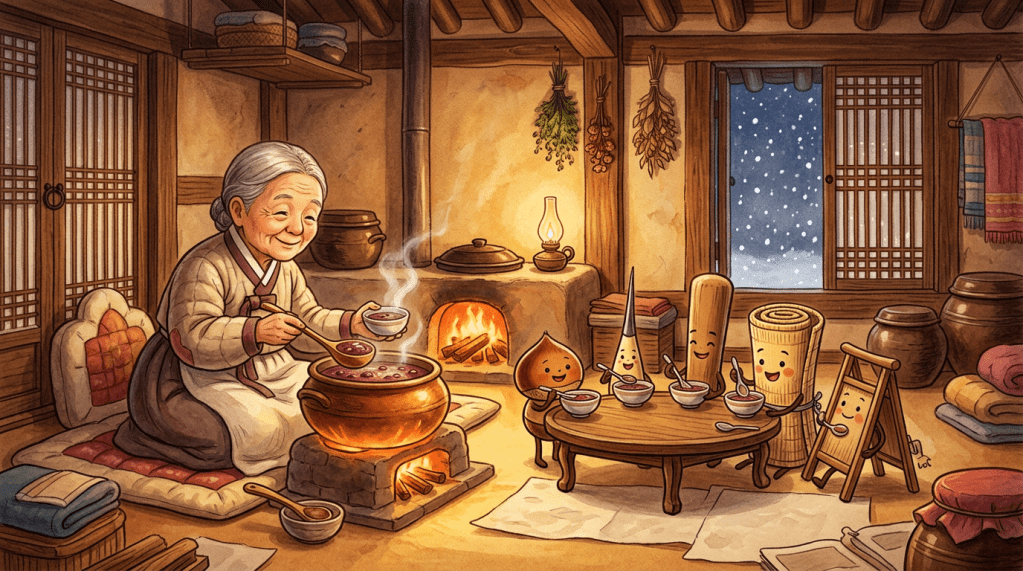
Another reason the folktale continues to be loved is its emotional warmth. The old woman is poor and vulnerable, yet she is generous even in danger. She shares her porridge with the visitors, and in return they protect her. This exchange of kindness and loyalty gives the story its heart. It is not only a tale of survival, but also a tale of community. The old woman does not win because she is powerful. She wins because she is connected to others and because the small companions choose not to abandon her.
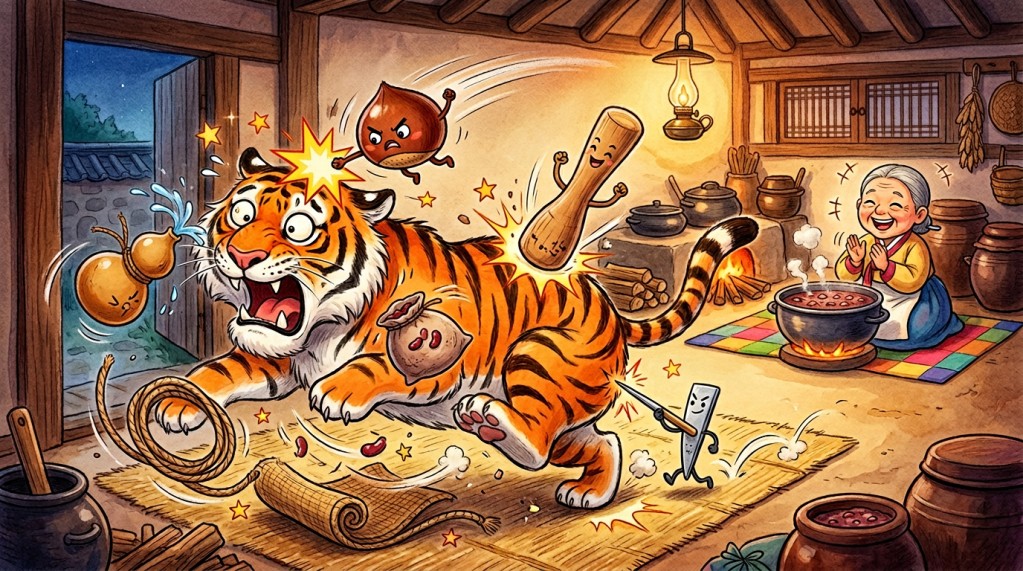
For modern readers, Patjuk Halmeom and the Tiger still feels fresh. It speaks to anyone who has ever felt small in front of a larger threat. It reminds us that even ordinary people and ordinary things can become powerful when they act together. That message gives the folktale a timeless charm. Funny, vivid, and full of winter warmth, it remains one of the most beloved Korean stories to introduce in a blog about traditional folktales.
Patjuk Halmeom and the Tiger is a classic Korean folktale about an old woman who escapes a hungry tiger with the help of clever little companions and a pot of red bean porridge. Warm, funny, and full of heart, the story shows that even the smallest helpers can defeat great danger.
 KOREAN FOLKTALES
Leave a comment