
Short Intro:
The Gold Axe and the Silver Axe is a beloved story in Korea about a poor woodcutter who is rewarded for honesty after losing his iron axe in a pond. Through a magical encounter with a mysterious old man, the tale teaches that truthfulness brings blessing while greed leads to loss.
Among the best-known children’s stories in Korea, The Gold Axe and the Silver Axe remains one of the clearest and most memorable lessons about honesty. The tale is simple: a poor woodcutter loses his old iron axe in a pond, meets a mysterious old man, and is rewarded for telling the truth. Because of its direct moral and vivid magical scene, it has long been loved in schoolbooks and story collections for children.
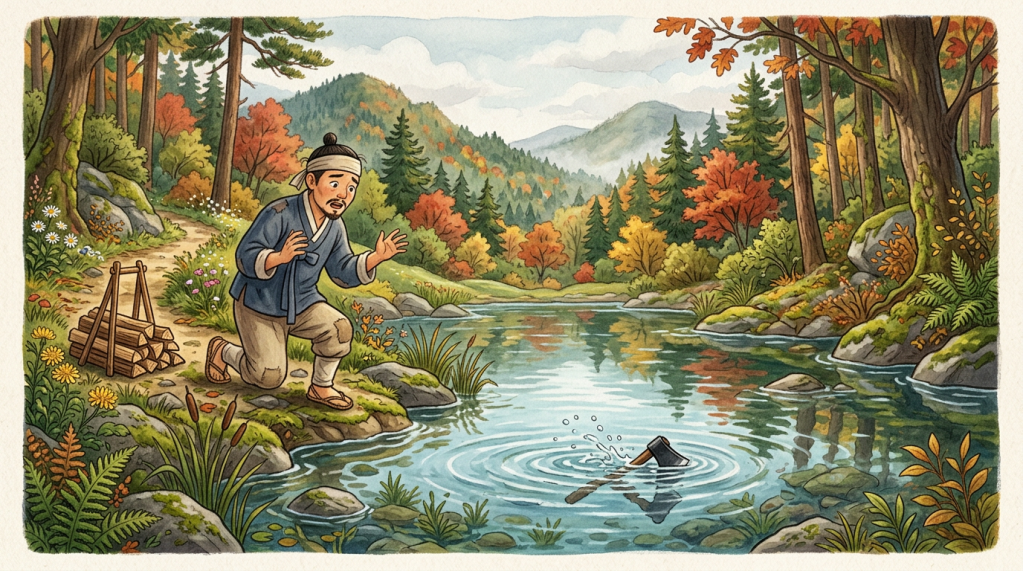
The story begins with an honest woodcutter working near a pond in the mountains. While cutting wood, he accidentally drops his only axe into the water. It is not a fine or valuable tool, but it is all he has. As he grieves beside the pond, an old white-bearded figure rises from the water and asks what has happened. The old man then disappears beneath the surface and returns holding a golden axe.
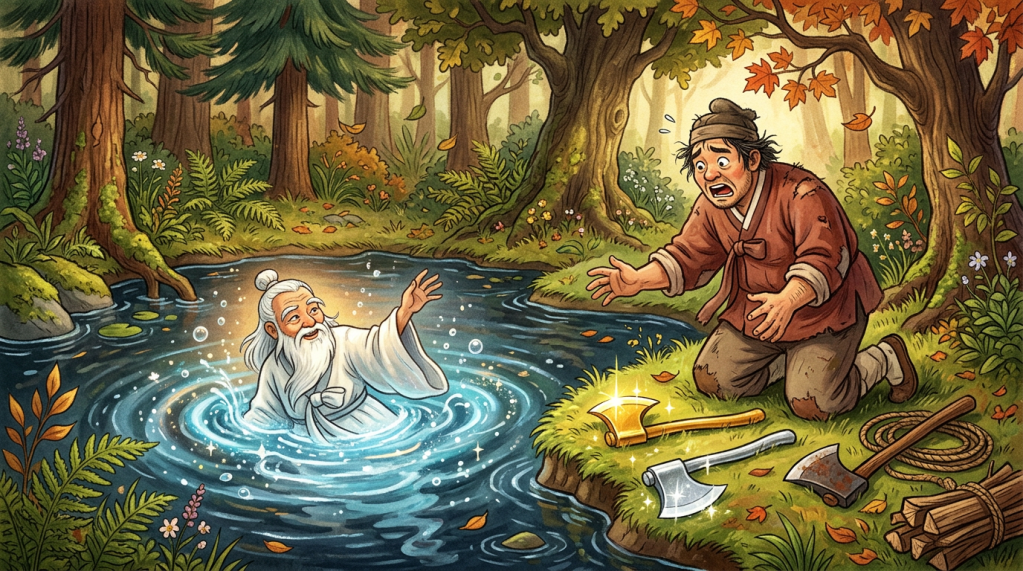
When the old man asks whether the golden axe belongs to him, the woodcutter answers honestly that it does not. Then the old man shows him a silver axe, but again the woodcutter says it is not his. Finally, the old man presents the old iron axe, and the woodcutter immediately recognizes it as his own. Moved by the man’s honesty, the old figure rewards him by giving him all three axes.
News of the reward spreads, and soon a greedy neighbor decides to copy what happened. He goes to the same pond and deliberately throws in his axe, hoping to gain treasure for himself. When the mysterious old man appears and offers the golden axe, the greedy woodcutter lies and claims it as his. He does the same with the silver axe. Angered by the lies, the old man disappears, and the greedy man loses everything, even the iron axe he brought with him.

What makes this tale so powerful is its perfect contrast between honesty and greed. The honest woodcutter does not reach for what is glittering and valuable; he simply asks for what is truly his. The greedy man, by contrast, wants more than he deserves and ends up with less than he began with. The lesson is unforgettable: if you chase what is not rightfully yours, you may lose even what you already have.
In Korea, this story became especially familiar through children’s books and school materials, which helped it settle into popular storytelling culture. The Korean encyclopedia notes that it is also known by names such as The Honest Woodcutter and The Gold Axe, Silver Axe, and Iron Axe. That long educational use is one reason the tale feels so deeply rooted in childhood memory for many Korean readers today.
For modern readers, the message still feels relevant. In daily life, people are often tempted by quick gain, exaggeration, or dishonesty. Yet this folktale reminds us that character matters more than immediate reward. Truthfulness may seem humble at first, like an old iron axe, but in the end it proves more valuable than gold.
 KOREAN FOLKTALES
Leave a comment